
 Ryan Douglas
HIIT Cardio for Fat Loss – The Complete Guide
October 30, 2019 Ryan Douglas Cardio, Training 0(Last Updated On: September 25, 2023)
"In this article, we are going to tell you everything you need to know about HIIT cardio.
Not only that, we are going to show you the research to back it up.
Let’s get started.

What is HIIT Cardio
HIIT stands for High-Intensity Interval Training. This is a form of cardio where you perform an intense exercise like sprints for a short period of time, usually 15-60 seconds followed by a rest or active recovery period. Rest/active recovery periods are usually 30-120 seconds but can be longer depending on the exercise and then you perform the intense exercise again and repeat.
This can be done for just a few rounds to as many as 15 rounds. The number of rounds depends on what exercise you are performing and what kind of shape you are in. If you are just starting out you should only do a few rounds then build up as you get better conditioned.
And when we say sprint we don’t mean 'just kinda go hard'. For the HIIT to work properly you should be going between 90-100% maximum effort. Over the years somehow the high-intensity part has become lost among many the trainers and people who perform HIIT.

Related: 5 HIIT Sprint Workouts That Blast Fat
What are the benefits of HIIT Cardio?
There are several benefits to HIIT cardio, the first is that it takes much less time than doing regular steady-state cardio for 50 minutes. It is also much less boring.
The main benefit of HIIT is that it also burns much more fat than steady-state cardio does in much less time. It is also ideal for those looking to keep and build muscle while losing fat.
Another lesser-known benefit is that HIIT also boosts your endurance. We don’t just mean your sprinting endurance either, it actually boosts your long-distance endurance as well.
The Research That Backs up HIIT
Just in case you thought we were totally lying about the benefits HIIT provides, we figured we would give you some research to back us up.
One of my favorite studies is this 12-week study done by McMaster University, Hamilton, ON, Canada. The study had 27 sedentary men broken up into 3 groups, one did interval sprint training, one did steady-state cardio and one did not train at all. At the end of the 12-week study, the group doing the interval sprint training lost more body fat than the steady-state cardio group and more than the control group.
Here’s where it gets crazy…
You are probably thinking they had to do a lot of sprints to lose more body fat than the steady-state group, you would be so very wrong.
In fact, the sprint group only did 1 minute total of sprint work. Their workout involved 3×20-second all-out’ cycle sprints with 2 minutes of moderate cycling between sprints. Meanwhile, the steady-state group did 45 minutes of continuous cycling at 70% maximal heart rate. Both groups also performed a 2-minute warm-up and 3-minute cool-down at 50W. Both groups performed 3 workouts per week.
That is insane! Just 3-20 second sprints burned more fat than 50 minutes of continuous pedaling?! Just imagine how much more fat they could have burned had they done 6 sprints or more which they easily could have. Talk about getting a serious bang for your buck.
Not convinced yet? Check out this review in the British Journal of Medicine where they looked at 36 different studies involving HIIT compared to moderate-intensity continues training. The review conclusion states that 'Interval training provided 28.5% greater reductions in total absolute fat mass (kg) than MOD' (moderate intensity continues training).
Research that shows HIIT builds endurance too
This study was done by the Department of Physical Education and Sport Sciences at the University of Limerick in Limerick, Ireland. The 8-week study compared the effects of long-distance training vs HIIT in rowers using 19 well-trained rowing participants.
Participants were randomly assigned to each group. The long-distance group did 10 weekly aerobic sessions while the HIIT group also performed 10 weekly sessions, 8 were aerobic and 2 were HIIT using 2.5-minute interval training.
The final conclusion of the study was that 'Eight weeks of HIIT performed at 100% PPO (peak power output) is more effective than LSD (long slow distance training) in improving performance and aerobic characteristics in well-trained rowers'.
Bottom line…
HIIT is proven to burn more fat and also improve endurance.
HIIT lowers blood sugar
Ok, one last thing here before I literally bore you to tears with research but this is another good one.
I am not going to bore you with the details on this one but here is the study, check it out and get your nerd on. (Hint: HIIT was shown to lower blood sugar levels)
Enough with the studies, let’s move on.
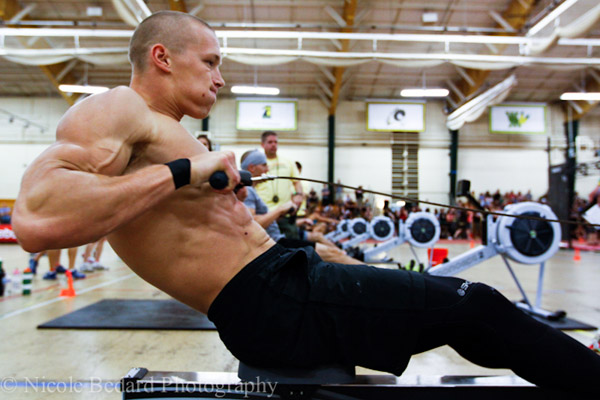
Diet with HIIT
No, I am not going to give you some HIIT diet plan here or anything, that would be a bit ridiculous. Plus there is no such thing so there’s that.
I do want to mention that if you are trying to lose weight or get ripped by using HIIT you should most definitely keep your diet in check though.
You will be wasting your time and energy if you think you are going to go to the track and do some 20-minute HIIT workout then go out and chow down 5 pieces of pizza and a dozen wings and that somehow you will still get ripped. I wish it were that easy.
If you want some sort of eating guidelines you can check out our articles 5 Nutrition Rules for Healthy Living or Eating for Ripped Abs.
The saying 'abs are made in the kitchen' is true. Whether you are trying to lose weight or get ripped your diet needs to be on point or you can do HIIT until the cows come home and it isn’t going to make a difference.
How often to do HIIT?
While HIIT is very effective at burning fat and improving your endurance you don’t want to be doing it 5 days a week. Your body needs recovery time and you will burn yourself out if you do it too often.
Two or maybe three times a week is about the most you would want to do HIIT and you definitely want to take a day off in between your HIIT training days.
If you are a beginner I would start off with just one HIIT session a week then move up to 2 as you get into better shape. If you really want to get hardcore you can go to three sessions once you are in good shape a week but I think 2 per week is plenty for most people.
HIIT vs Steady State Cardio
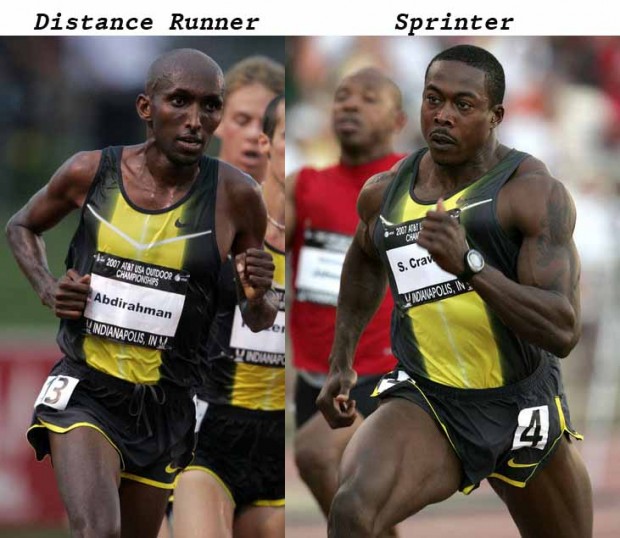
When comparing HIIT and steady-state cardio it all depends on what your goals are.
If your goals are to burn more fat in less time then HIIT is the obvious choice as we have already discussed. HIIT will also help you preserve and even build muscle too. Think of it this way, have you ever looked at a long-distance runner’s body compared to a sprinter’s body? Sprinters are strong and muscled, long-distance runners are slight and some are almost frail. This is at least partly due to the training they do and the effect it has on the body.
Steady-state cardio isn’t without its advantages though. Steady-state cardio is less stressful on your heart and body and while some folks find it boring other people find steady-state cardio to be more enjoyable.
Also, while it has been shown that HIIT improves your endurance you aren’t going to want to just do HIIT training to get ready to run a 10k. While HIIT should be a part of your endurance training steady-state cardio is still the way to go for the majority of your training. [...]"
(...To continue reading about How To Drop Fat with HIIT, click through to Ryan's article above on The Athletic Build...)

Ryan is a former college wrestler and lifelong fitness fanatic. He has run half marathons, done mud runs, placed in body transformation contests, coached wrestling, and now coaches girls’ soccer. Not to mention he has also tried literally hundreds of supplements over the years and has a vast and thorough supplement knowledge. He has written for Muscle & Strength, Testosterone Junkie, The Sport Review and other publications. He is also the editor-in-chief of this website and has over 25 years of experience in the fitness industry. Feel free to connect with him on his LinkedIn page below.